Kubernetes promised a universal control plane for modern infrastructure. And it delivered — but only at the primitive level.
Out of the box, Kubernetes understands Pods, Deployments, Services, ConfigMaps, and little else.
What it does not understand is your business logic:
-
What does a “compliant network service” mean?
-
How do you upgrade a stateful telecom workload without traffic loss?
-
How do you enforce organization-wide governance automatically?
This gap is exactly where Kubernetes Operators come in.
In this article, we’ll go deep into:
-
What a custom Kubernetes Operator really is (beyond the buzzwords)
-
Why Go (Golang) is the dominant language for Operators
-
Why enterprise platforms cannot scale safely without Operators
-
How Operators differ from Helm, scripts, and GitOps
-
A practical Go-based Operator design walkthrough
-
Common mistakes teams make (and how to avoid them)
-
Real-world enterprise use cases
-
Where Operators are heading next
This is written for engineers who already understand Kubernetes basics and want to build production-grade platforms, not toy demos.
Why Kubernetes Alone Is Not Enough for Enterprises
Kubernetes excels at generic orchestration, but enterprises rarely deal in generic problems.
Let’s look at typical enterprise requirements:
-
Day-2 operations: upgrades, backups, drift correction
-
Domain-specific automation: telecom NFs, databases, AI pipelines
-
Governance & compliance: policy enforcement, approvals, audits
-
Stateful lifecycle management across versions and environments
-
Self-healing beyond restarts
Kubernetes does none of this by default.
The Core Problem
Kubernetes only knows desired state of resources, not desired state of systems.
Example:
“Ensure this payment platform is always PCI compliant, upgraded quarterly, backed up daily, and auto-remediated on failure.”
That logic must live outside Kubernetes — unless you teach Kubernetes how to understand it.
That teaching mechanism is the Operator pattern.
What Is a Kubernetes Operator (Really)?
At its core, an Operator is:
A Kubernetes controller that encodes human operational knowledge into software.
Technically, an Operator consists of:
-
Custom Resource Definitions (CRDs)
Extend the Kubernetes API with domain-specific objects -
Controller (written in Go)
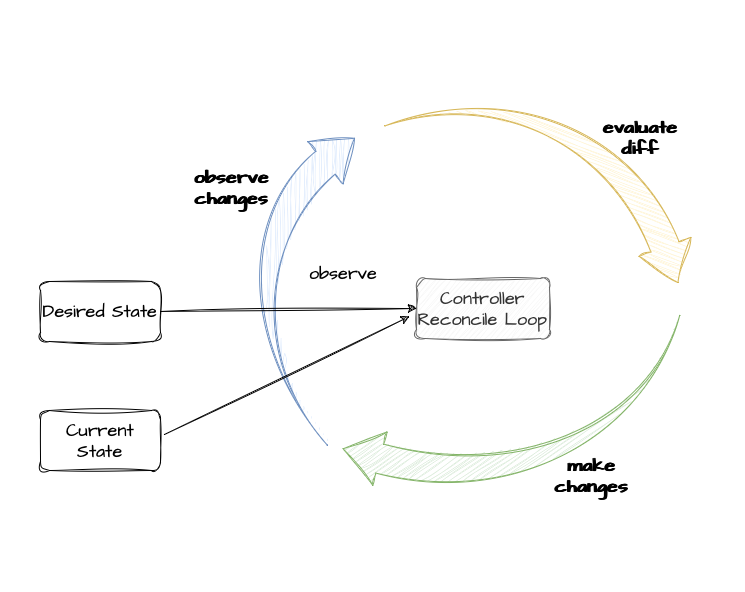
Watches those resources and reconciles actual state → desired state -
Reconciliation Loop
Continuously corrects drift, failures, and external changes
A Simple Mental Model
Think of an Operator as:
-
A site reliability engineer
-
Who never sleeps
-
Watches your application continuously
-
Applies best practices automatically
-
And reacts instantly to failures or changes
Why Golang Is the Preferred Language for Operators
While Operators can be written in other languages, Go is the enterprise standard.
Why Go Dominates Operator Development
1. Kubernetes Is Written in Go
-
Native Kubernetes APIs
-
First-class client libraries
-
No translation layers or wrappers
2. Performance & Predictability
-
Low memory overhead
-
Fast startup times
-
Deterministic behavior (critical for controllers)
3. Strong Concurrency Model
-
Goroutines fit naturally with event-driven reconciliation
-
Scales well with thousands of watched resources
4. Ecosystem & Tooling
-
controller-runtime -
kubebuilder -
operator-sdk -
Mature testing frameworks
In production clusters with thousands of objects, Go-based Operators consistently outperform alternatives.
Why Enterprises Actually Need Custom Operators
Helm charts, CI/CD pipelines, and GitOps tools are useful — but they stop at deployment.
Enterprises need lifecycle intelligence.
Enterprise Pain Points Without Operators
| Problem | Without Operator | With Operator |
|---|---|---|
| Upgrades | Manual or scripted | Automated, version-aware |
| Failures | Restart pods | Diagnose + remediate |
| Compliance | Periodic audits | Continuous enforcement |
| State drift | Silent | Automatically corrected |
| Knowledge | Tribal | Codified |
Example: Helm vs Operator
Helm can install a database.
But it cannot:
-
Coordinate backups before upgrades
-
Block upgrades if replication is unhealthy
-
Rebuild replicas after node failure
-
Enforce encryption policies continuously
An Operator can.
Operator Architecture (Production Grade)

Key Components
1. Custom Resource (CR)
This becomes a first-class Kubernetes object.
2. Controller (Go)
The controller:
-
Watches
NetworkService -
Observes cluster state
-
Calls APIs (K8s + external systems)
-
Reconciles differences
3. Reconciliation Loop
Pseudocode:
This loop never ends.
Hands-On: Designing a Custom Operator in Go
Step 1: Scaffold the Project
Step 2: Create API
This generates:
-
CRD schema
-
Controller skeleton
-
RBAC rules
Step 3: Define the Spec & Status
Spec = desired state
Status = observed state
Step 4: Implement Reconciliation Logic
Key responsibilities:
-
Validate configuration
-
Create/update Deployments
-
Check health
-
Handle failures
-
Update status
This is where enterprise logic lives.
Real-World Enterprise Use Cases
1. Telecom & Network Functions
-
Rolling upgrades without traffic loss
-
Device compliance enforcement
-
Stateful coordination across zones
2. Databases & Stateful Platforms
-
Zero-downtime upgrades
-
Backup/restore orchestration
-
Topology-aware scaling
3. Internal Developer Platforms (IDP)
-
Golden-path services
-
Policy enforcement
-
Cost and quota governance
4. AI / ML Platforms
-
Model lifecycle management
-
GPU scheduling logic
-
Drift detection
Common Mistakes Teams Make
❌ Treating Operators Like Scripts
Operators must be:
-
Idempotent
-
Event-driven
-
Failure-aware
❌ Overloading Reconcile Loops
Avoid:
-
Blocking calls
-
Long-running jobs
-
Tight polling
Use:
-
Events
-
Work queues
-
External job controllers
❌ Ignoring Status & Observability
Enterprise Operators must expose:
-
Status fields
-
Events
-
Metrics
If you can’t observe it, you can’t operate it.
Operators vs GitOps: Not Either/Or
A common misconception:
“If we use GitOps, we don’t need Operators.”
Reality:
-
GitOps manages desired state
-
Operators manage runtime reality
They complement each other.
Best practice:
-
GitOps deploys CRs
-
Operators enforce behavior continuously
Security & Governance Benefits
Custom Operators enable:
-
Policy-as-code
-
Admission validation
-
Controlled upgrades
-
Automated rollback
-
Audit-friendly workflows
This is critical for regulated industries like finance, healthcare, and telecom.
Testing & Reliability (Enterprise Must-Haves)
A production Operator must include:
-
Unit tests for reconciliation logic
-
Envtest-based integration tests
-
Chaos scenarios (node loss, API failures)
-
Upgrade testing across versions
Operators are control-plane software — test them like one.
Future of Operators in Enterprise Platforms
Looking ahead:
-
Operators + AI-driven remediation
-
Cross-cluster Operators
-
Self-optimizing control loops
-
Policy-driven Operators as platform primitives
Enterprises are moving from:
“Deploy apps on Kubernetes”
to:
“Build platforms with Kubernetes”
Operators are the foundation of that shift.
Final Thoughts
Custom Kubernetes Operators written in Go are not optional for serious enterprise platforms.
They are:
-
The bridge between infrastructure and business logic
-
The codification of operational excellence
-
The only scalable way to manage complex, stateful systems on Kubernetes
If Kubernetes is the kernel, Operators are the device drivers of modern cloud platforms.
And in real-world production systems — especially at enterprise scale — nothing runs safely without them.

Comments
0To comment, choose whether you want to register or continue as a guest.