The Agent Permission Problem: Why AI Needs Its Own Identity Lifecycle
AI agents are crossing an important boundary: they are no longer limited to generating text or code. They can retrieve enterprise data, call APIs, modify workflows and execute tasks on a user’s behalf. That changes the security question from “What can the model generate?” to “What is this agent allowed to do right now?”
That distinction matters because traditional identity systems were largely designed around two familiar actors: humans with interactive sessions and software with relatively predictable service accounts. An agent can behave like neither. It may reason about a task, choose tools dynamically, delegate work and act at machine speed.
NIST has been explicitly examining identity and authorization for software and AI agents, while its 2026 security work continues to emphasize stronger controls around tokens, assertions, authorization and monitoring. OWASP’s Agent Control Standard similarly focuses on making agents inspectable, traceable and controllable at runtime.
Why service-account thinking is no longer enough
A conventional service account usually represents a known application with a defined purpose. Its permissions may be broad, but its behavior is relatively predictable because the application logic is predetermined.
An AI agent introduces a decision layer between the request and the action. The same agent may read a ticket, query a database, call an external API and open a pull request depending on what it encounters. If all of those actions inherit one long-lived identity, a mistake or compromised context can turn a narrow task into a much larger access event.
The practical implication is simple: an agent should not automatically inherit everything its human sponsor can access.
Think in terms of an agent identity lifecycle
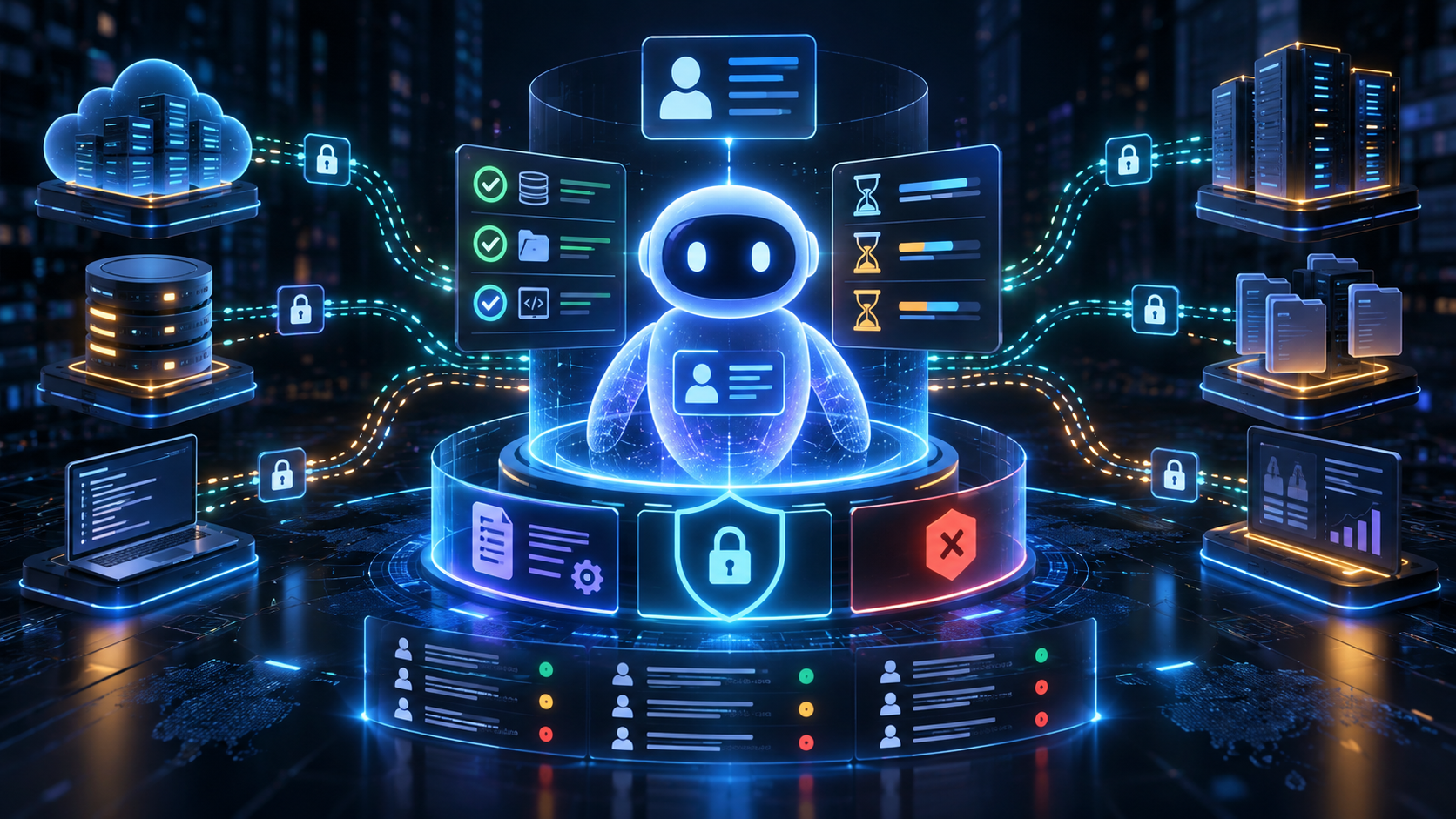
A useful architecture treats an AI agent as a first-class identity with a lifecycle similar to any other privileged workload.
1. Establish identity
Every production agent should have a distinguishable identity rather than hiding behind a shared API key or a human credential. The identity should tell security systems which agent instance or workload is acting, which application created it and, where applicable, which user initiated the task.
2. Issue scoped authority
Authorization should describe the smallest set of actions required for the current job. An agent that needs to read a support ticket does not automatically need permission to delete records. An agent preparing a deployment can be allowed to inspect build artifacts without receiving unrestricted production write access.
3. Make credentials short-lived
Long-lived secrets create unnecessary blast radius. Short-lived credentials and renewable authorization reduce the time window in which a stolen token remains useful. NIST’s September 2026 guidance on protecting tokens and assertions reinforces the importance of secure token lifecycle controls, verification and revocation.
4. Record delegated authority
Logs should answer more than “which API key was used?” A useful audit record should connect the human or system that initiated the task, the agent identity, the authorization granted, the tools invoked, the resources touched and the resulting action.
5. Revoke at runtime
Agents need a practical kill switch. If an agent begins making unexpected calls, administrators should be able to revoke its current authority without waiting for a model change or application redeployment.
The missing layer: action authorization
Authentication answers who is acting. Traditional authorization answers what can that identity access. Agentic systems increasingly need a third question: what is this agent allowed to do with that access in this particular situation?
Consider an incident-response agent. It may legitimately read security alerts and collect diagnostic data. That does not mean it should automatically isolate production hosts, rotate credentials or modify firewall policy. Those actions have materially different consequences.
A safer design separates permissions by action risk. Low-impact reads can be automated more freely. Sensitive writes can require additional policy checks, stronger authorization or human approval.
Runtime policy beats prompt-only guardrails
Prompt instructions and model-level guardrails are useful, but they should not be the final security boundary. If an agent is instructed not to access a particular system, the infrastructure should still enforce that restriction independently.
OWASP’s September 2026 Agent Control Standard describes a runtime-control approach in which agent platforms expose hooks for policy enforcement and observability. The architectural lesson is broader than any one standard: security controls should sit at the execution layer, where tool calls and real-world actions actually happen.
A practical reference architecture
A production deployment can be organized into six layers:
- Agent registry: records what agents exist, their owners, purpose and environment.
- Identity provider: issues a distinct machine identity for each agent or workload.
- Policy engine: evaluates requested actions against identity, resource, context and risk.
- Credential broker: provides short-lived credentials instead of embedding permanent secrets in prompts or agent configuration.
- Execution gateway: mediates high-value tool calls and can block or require approval for sensitive actions.
- Audit and detection: records decisions and actions so security teams can investigate behavior and revoke access quickly.
This model also creates a cleaner separation of concerns. The model can reason about what to do, while deterministic infrastructure decides whether it is allowed.
What engineering teams can implement now
You do not need a completely new IAM platform to begin. Start by inventorying every production agent and documenting the identities, credentials, tools and datasets each one can reach.
Then remove shared credentials, reduce permissions to task-specific scopes and make sensitive writes pass through a policy-controlled gateway. Add structured audit fields for agent identity, initiating principal, requested action, authorization decision and outcome.
Finally, test the controls under failure conditions. Ask what happens when an agent receives malicious instructions, encounters poisoned content, requests an unexpected tool or begins making calls outside its normal pattern. The answer should come from infrastructure controls—not from hoping the model follows a prompt.
The bigger shift
The rise of agentic AI is turning identity into part of the AI architecture itself. NIST’s work on agent identity and authorization and OWASP’s recent runtime-control work both point toward the same engineering direction: autonomous software needs explicit identity, bounded authority and observable actions.
The goal is not to eliminate autonomy. It is to make autonomy governable.
For engineering teams, that means treating every production agent as a security principal with a lifecycle: create it, identify it, authorize it, monitor it, constrain it and revoke it. Once that foundation exists, adding more capable agents becomes an engineering scaling problem rather than an uncontrolled permissions problem.
Comments
0To comment, choose whether you want to register or continue as a guest.