A year or two ago, learning how to “talk” to AI felt like a superpower.

You described what you wanted.
The model responded with code, prose, insights, or answers.
Entire workflows suddenly felt effortless.
Prompt engineering quickly became a buzzword—and for good reason. It lowered the barrier to entry for advanced AI and made powerful models accessible to almost anyone.
But once AI moved beyond demos and into real products, something changed.
Systems became unreliable.
Outputs drifted.
Hallucinations appeared in critical paths.
Costs increased quietly.
Trust became fragile.
That’s when many teams reached the same uncomfortable conclusion:
Prompt engineering alone does not scale to real-world AI systems.
This article explores why prompt-only AI is failing in production, what successful teams are doing instead, and how the industry is shifting from using AI to engineering AI systems.
This is not a rejection of prompts—it’s an evolution beyond them.
Why This Topic Matters Now
If AI is just a chatbot, prompts are enough.
But modern AI is being asked to:
-
assist customer support at scale,
-
generate and review production code,
-
summarize sensitive documents,
-
recommend actions,
-
automate workflows,
-
support decision-making.
In these contexts, failures are not cosmetic. They are operational risks.
In production systems, AI problems show up as:
-
inconsistent behavior between sessions,
-
confident but incorrect outputs,
-
lack of explainability,
-
compliance concerns,
-
escalating infrastructure costs.
Prompt engineering does not address these issues because they are system problems, not language problems.
The Prompt Era: Necessary, But Incomplete
Prompt engineering played a crucial role in early AI adoption.
It helped people:
-
understand model capabilities,
-
experiment quickly,
-
build prototypes in hours instead of weeks.
But prompts come with hard structural limits.
1. Prompts Are Fragile
Small wording changes can lead to dramatically different results. This unpredictability is unacceptable in systems that must behave consistently.
2. Prompts Are Non-Deterministic
The same input does not reliably produce the same output. For business workflows, this creates risk.
3. Prompts Do Not Create Memory
Context windows are not memory systems. Re-injecting history into prompts increases cost and complexity.
4. Prompts Cannot Enforce Governance
Access control, audit logs, safety constraints, and compliance cannot be guaranteed through text instructions.
Prompts are powerful—but they are interfaces, not foundations.
The Mental Shift: From Asking AI to Designing Intelligence
One of the most damaging misconceptions today is treating AI as something you query rather than something you design.
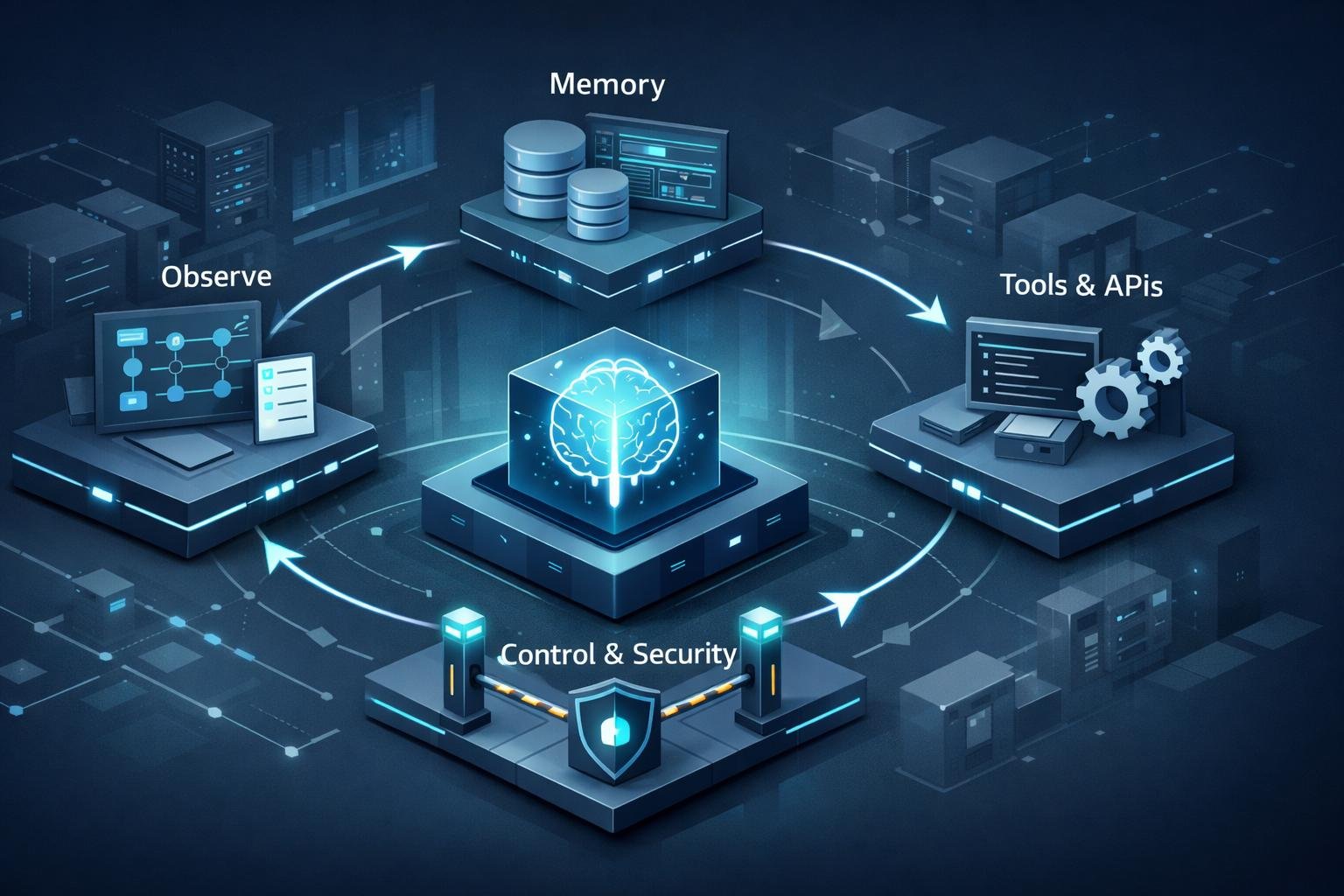
In real systems, intelligence emerges from composition:
-
data pipelines,
-
retrieval mechanisms,
-
memory layers,
-
deterministic logic,
-
tool execution,
-
evaluation loops.
Teams that succeed stop asking:
“What prompt should we write?”
And start asking:
“What system should this AI be part of?”
Layer 1: Models Are Becoming Commodities
Model quality still matters—but it is no longer the primary differentiator.
Teams can switch between:
-
proprietary APIs,
-
open-source models,
-
fine-tuned domain variants,
-
multimodal architectures.
If changing the model breaks your product, your system is fragile.
Long-term value comes from:
-
how data flows through the system,
-
how decisions are orchestrated,
-
how behavior is constrained and observed.
Layer 2: Grounding AI with Retrieval (RAG)
One of the first production failures teams encounter is hallucination.
No model, regardless of size, can reliably “know” your internal data or keep up with real-time changes. This is why retrieval-augmented generation (RAG) has become a foundational pattern.
Instead of relying on the model’s memory, RAG:
-
Retrieves relevant information from trusted sources
-
Injects that information at runtime
-
Generates responses grounded in real data
For a deeper explanation, see this internal guide on
retrieval-augmented generation (RAG)
and this external reference from Pinecone:
https://www.pinecone.io/learn/retrieval-augmented-generation/
In real production systems, RAG:
-
reduces hallucinations,
-
improves explainability,
-
enables private data usage,
-
simplifies updates without retraining models.
But RAG solves knowledge grounding, not intelligence.
Layer 3: Memory Is Infrastructure, Not a Prompt Hack
Human intelligence relies on memory. AI systems should too.
Production-grade AI typically needs:
-
short-term memory (session context),
-
long-term memory (user preferences),
-
episodic memory (past actions and outcomes),
-
semantic memory (structured knowledge).
Trying to encode memory inside prompts leads to:
-
rising token costs,
-
degraded performance,
-
brittle behavior.
Well-designed systems treat memory as a first-class component, not a text blob.
Layer 4: From Text Generation to Action
AI becomes valuable when it can do things, not just say things.
Modern systems allow models to:
-
call APIs,
-
query databases,
-
trigger workflows,
-
update records,
-
escalate to humans when required.
This is where AI shifts from assistant to agent.
However, action-capable AI must be constrained. Tool execution requires:
-
permissions,
-
validation,
-
logging,
-
rollback strategies.
For a broader look at this transition, see:
https://www.microsoft.com/en-us/research/blog/autonomous-agents-and-the-future-of-ai/
Layer 5: Orchestration Is Where Intelligence Lives
Intelligence is rarely a single model call.
In production, it involves:
-
branching logic,
-
retries and fallbacks,
-
multi-step reasoning,
-
human-in-the-loop checkpoints,
-
evaluation and feedback loops.
A common anti-pattern is embedding logic inside massive prompts. This quickly becomes:
-
unreadable,
-
untestable,
-
unmaintainable.
Successful teams externalize logic into workflows and use AI where uncertainty actually exists.
Prompt-Centric vs System-Centric AI
| Dimension | Prompt-Centric AI | System-Centric AI |
|---|---|---|
| Reliability | Fragile | Predictable |
| Debugging | Trial and error | Observable |
| Scalability | Limited | Designed-in |
| Compliance | Manual | Enforced |
| Cost control | Hard | Manageable |
| Long-term value | Weak | Durable |
This difference becomes obvious once systems reach real users.
Common Misconceptions That Slow Teams Down
“We just need better prompts”
Better prompts improve edges—not foundations.
“Models will fix this soon”
Models improve, but architecture determines behavior.
“AI doesn’t need testing”
AI systems require more testing, not less.
“Agents are just prompts with tools”
Agents are stateful systems with goals, not clever text templates.
What Actually Works in Production
Teams building reliable AI systems consistently invest in:
-
clear separation between AI and deterministic logic,
-
observability and replayability,
-
evaluation metrics beyond “looks good”,
-
cost monitoring and caching,
-
explicit failure handling.
This aligns closely with modern
AI system design principles
and best practices for
AI observability and monitoring.
Trust Is the Real Bottleneck
As AI influences real outcomes, trust becomes the hardest problem.
Trust is built through:
-
transparency,
-
consistency,
-
auditability,
-
constrained autonomy.
This is why trustworthy AI engineering matters more than clever prompts.
You can explore this further here:
https://futuretechdiaries.com/trustworthy-ai-engineering/
and from a policy perspective:
https://www.weforum.org/agenda/2023/06/trustworthy-ai-principles/
Where AI Is Headed Next
Based on current production trends, several things are becoming clear:
-
Prompts will fade into the background
Users will care about outcomes, not instructions. -
AI will be treated like infrastructure
With tests, metrics, SLAs, and incident reviews. -
Systems will matter more than models
Data quality, workflows, and integration will define success. -
AI engineering will replace prompt engineering
As a core professional discipline.
Mini FAQ
Is prompt engineering still useful?
Yes—but as a supporting skill, not a strategy.
Do small teams need system-level AI design?
Even more than large teams. Constraints demand reliability.
Is this overengineering?
Only if your AI never leaves a demo.
What should engineers learn next?
AI system design, evaluation, observability, and governance.
Final Thoughts
The most important shift happening in AI today is not about bigger models or smarter prompts.
It’s about responsibility.
We are moving from asking AI questions to trusting AI with outcomes. That transition demands structure, discipline, and thoughtful engineering.
Prompts helped us get started.
But the future belongs to those who understand how to engineer intelligent systems, not just invoke them.
If AI is becoming infrastructure, we must start treating it like infrastructure.
And infrastructure has never been built on clever words alone.
If you’ve taken AI from experiments into production, you’ve likely felt this shift already. That shared experience is shaping the next generation of AI systems.

Comments
0To comment, choose whether you want to register or continue as a guest.