AI agents are rapidly evolving from experimental demos into production-grade systems. Today, they handle customer conversations, automate workflows, assist developers, analyze large datasets, and increasingly make decisions that affect real users and businesses.
Yet as adoption accelerates, one question consistently surfaces across engineering teams: Can we actually trust these agents in production?
Trustworthy AI agents are not defined by perfection. Instead, they are systems whose behavior is predictable, observable, explainable, and safe under failure. In real-world environments, reliability and transparency matter far more than raw model intelligence.
From decades of building large-scale software systems, we know a simple truth: systems fail, assumptions break, and edge cases always exist. AI agents amplify this reality by introducing probabilistic reasoning into otherwise deterministic architectures.
This article is an engineering-focused playbook for building trustworthy AI agents. It is written for technologists seeking practical guidance—not marketing promises—and grounded in real production experience.
What Makes an AI Agent Trustworthy?
Trust in AI is often discussed in abstract or ethical terms. From an engineering perspective, trust is far more concrete and measurable.
A trustworthy AI agent consistently demonstrates the following qualities:
- Predictability – Similar inputs lead to consistent, explainable behavior
- Transparency – Decisions can be inspected, traced, and understood
- Safety – Actions are constrained, validated, and permissioned
- Observability – Every step can be logged, replayed, and analyzed
- Recoverability – Failures are detected early and handled explicitly
Importantly, trust does not imply error-free operation. A trustworthy agent may still fail—but it fails in ways engineers can debug, reason about, and fix.
Pillar 1: Determinism Where It Matters
Why Purely Probabilistic Agents Fail in Production
Large language models are probabilistic by design. This flexibility enables creativity and generalization, but it becomes a liability when agents are responsible for workflows, decisions, or system actions.
In production systems, excessive non-determinism introduces:
- Hard-to-reproduce bugs
- Inconsistent user experiences
- Increased operational and compliance risk
Engineering Principle
Not every part of an AI agent must be deterministic. However, critical decision paths must be.
Practical Techniques
- Control randomness by using low temperature for decision-making steps
- Reserve higher creativity for non-critical or user-facing tasks
- Enforce structured outputs using JSON or schema-based responses
- Automatically reject malformed or incomplete outputs
- Use explicit state transitions rather than free-form reasoning
By introducing structure and constraints, teams reduce ambiguity and improve reliability—without sacrificing agent capability.
Pillar 2: Observability by Design
Why Agent Failures Are Hard to Debug
Traditional software systems fail loudly, with logs, metrics, and stack traces. AI agents often fail silently—or worse, fail confidently with incorrect outputs.
Without proper observability, teams struggle to answer fundamental questions:
- Why did the agent choose this action?
- What context influenced the decision?
- Where did hallucination or drift occur?
Engineering Rule
If you cannot replay an agent’s behavior, you cannot trust it.
What to Log
At a minimum, production-grade AI agents should log:
- Inputs and prompts (with sensitive data masked)
- Model responses
- Tool calls and parameters
- Intermediate decisions or reasoning steps
- Final actions taken
- Latency, cost, and token usage
Agent Run Replay
One of the most powerful practices in production systems is agent run replay:
- Every agent execution is recorded as a timeline
- Engineers can replay runs step by step
- Failures become debuggable artifacts rather than mysteries
This single capability often marks the boundary between experimental agents and production-ready systems.
Pillar 3: Engineering Memory Explicitly
The Common Misconception
Many teams assume models “remember” context naturally. In reality, models operate only within a limited context window.
Trustworthy agents treat memory as a first-class subsystem, not an emergent side effect.
Types of Memory in AI Agents
| Memory Type | Purpose | Primary Risk |
|---|---|---|
| Short-term context | Immediate reasoning | Token overflow |
| Working memory | Task state tracking | State drift |
| Long-term memory | User facts and preferences | Staleness |
| Episodic memory | Past runs and outcomes | Bias accumulation |
Best Practices
- Separate verified facts from inferred conclusions
- Timestamp and version all stored memories
- Validate retrieved memories before use
- Never treat memory as unquestioned truth
In production systems, stale or incorrect memory often causes more harm than model errors themselves.
Pillar 4: Tool and Action Safety
Where Real Damage Happens
An agent’s internal reasoning is harmless. Its actions are not.
Agents capable of sending messages, modifying databases, triggering deployments, or executing financial operations must be treated as privileged system actors.
Safety Design Patterns
Action Gating
- Schema validation
- Permission checks
- Context verification
Read vs Write Separation
- Default agents to read-only access
- Require explicit escalation for write operations
Dry-Run Execution
- Simulate actions before execution
- Surface expected impact
- Require confirmation when risk is high
These patterns dramatically reduce the blast radius of agent failures.
Pillar 5: Continuous Evaluation, Not One-Time Testing
Why Traditional Testing Falls Short
AI agent behavior evolves as prompts, tools, and data change. Static testing alone cannot ensure long-term trustworthiness.
Effective Evaluation Layers
- Offline evaluation: scenario-based tests and known failure patterns
- Online evaluation: shadow runs and canary deployments
- Human review: sampled audits and error classification
Metrics That Matter
- Task completion rate
- Hallucination frequency
- Tool misuse incidents
- Error recovery time
- Cost versus outcome efficiency
These metrics provide meaningful insight into agent trustworthiness over time.
Pillar 6: Human-in-the-Loop Is a Strength
A common misconception is that human involvement signals system weakness. In practice, progressive autonomy builds trust.
Progressive Autonomy Model
| Stage | Agent Role |
|---|---|
| Assist | Suggest actions |
| Co-pilot | Execute with approval |
| Delegate | Execute with review |
| Autonomous | Execute with audit |
Skipping stages often leads to user resistance, loss of trust, or operational risk.
Reference Architecture for Trustworthy AI Agents
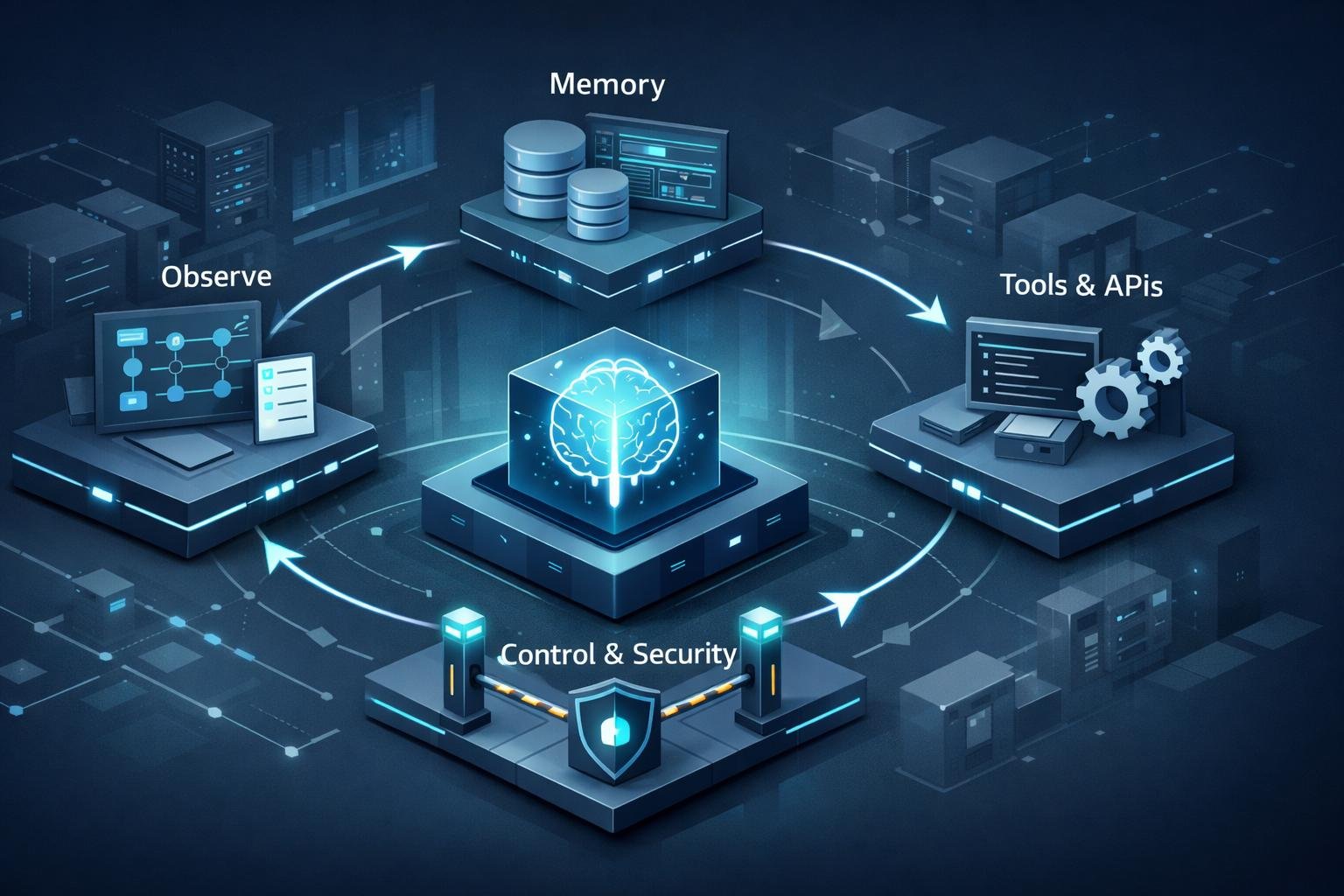
A production-ready agent architecture typically includes:
- Input Layer – User requests and context enrichment
- Reasoning Layer – Structured prompts and decision logic
- Memory Layer – Retrieval, validation, and expiration
- Action Layer – Tool adapters with safety checks
- Observability Layer – Logs, metrics, and replay
- Control Layer – Policies, approvals, and escalation
Clear separation of concerns transforms AI agents into maintainable, auditable systems.
Common Engineering Mistakes
- Over-reliance on prompt engineering
Fix: Move logic into code and schemas. - Treating model output as ground truth
Fix: Validate externally whenever possible. - No explicit failure design
Fix: Define failure states and escalation paths.
Conclusion: Trust Is an Engineering Discipline
Trustworthy AI agents are not created through better prompts alone. They are built through thoughtful system design, clear constraints, deep observability, and continuous evaluation.
In software engineering, we learned long ago that “it works locally” is not enough. AI agents demand the same maturity.
Teams that treat agents as production systems—rather than magical entities—will build solutions that scale, endure, and earn trust.
If you are building AI agents today, start with trust. Everything else compounds from there.

Comments
0To comment, choose whether you want to register or continue as a guest.