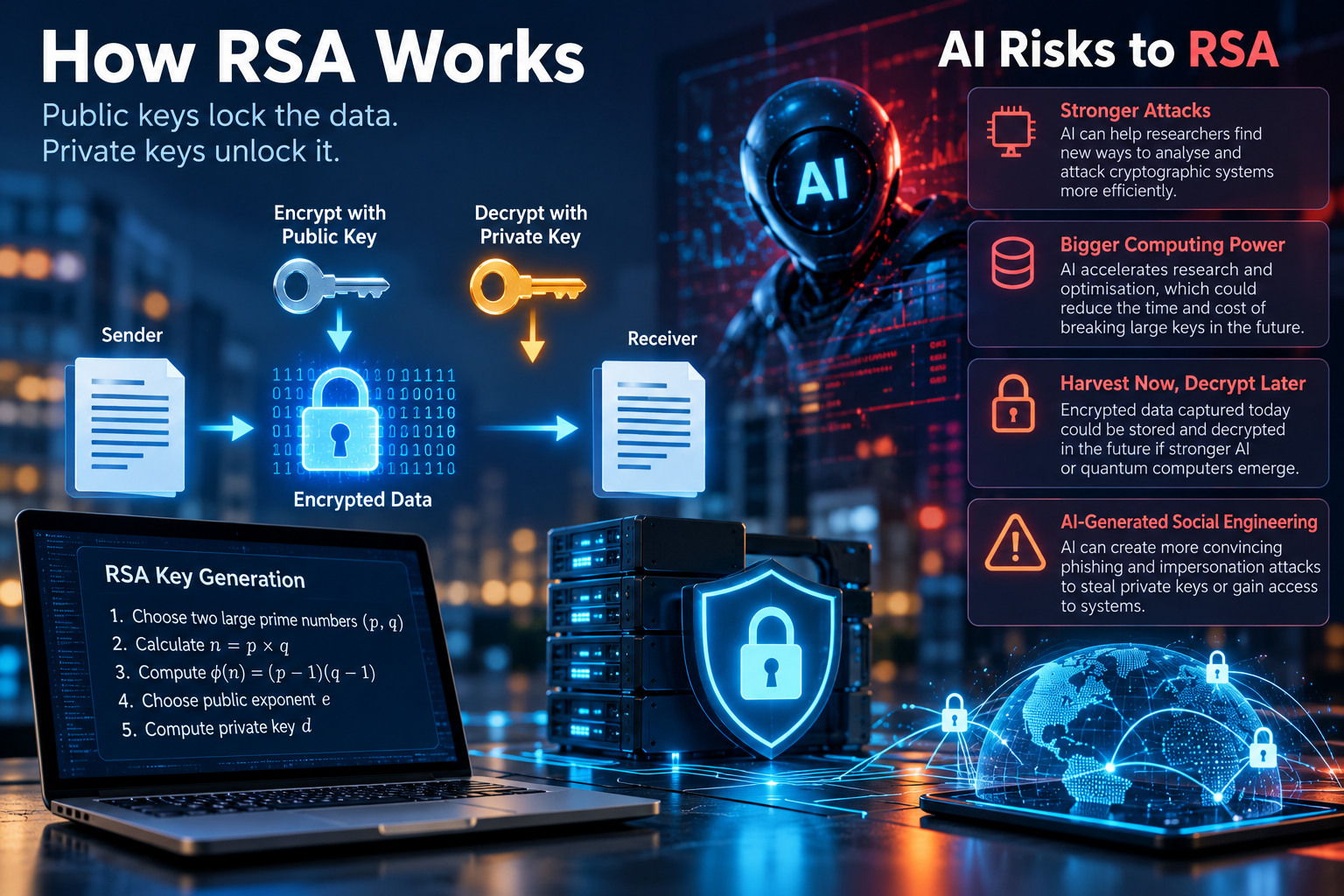
RSA is one of the best-known public-key cryptography algorithms. It helps systems establish trust by using a public key that can be shared and a private key that must remain secret. RSA has been used for encryption and digital signatures, although modern secure connections typically use public-key cryptography to establish or protect symmetric keys rather than encrypting large amounts of data directly.
As artificial intelligence becomes more capable, a reasonable question follows: can AI break RSA? The useful answer is more nuanced than either “AI makes encryption obsolete” or “RSA is unaffected.” AI can help attackers find mistakes, automate reconnaissance and prioritize promising leads. It does not magically solve the underlying mathematical problem that protects correctly implemented RSA. The separate long-term concern is a sufficiently capable quantum computer, which could use Shor’s algorithm to factor RSA moduli.
What RSA is designed to do
RSA is an asymmetric cryptographic system. Its security relies on the practical difficulty of factoring a very large composite number into its prime factors using conventional computers. The public key contains a modulus, usually written as n, and a public exponent, e. The private key includes secret information that enables the corresponding private-key operation.
Key generation starts with two large, randomly selected prime numbers, commonly called p and q. The system multiplies them to create n = p × q, then calculates private key material using relationships derived from those primes. The public modulus can be shared, but recovering the original factors from a properly sized modulus is believed to be computationally infeasible for classical attackers when the key is generated and used correctly.
A simple way to picture the public and private keys
Think of the public key as a lock that anyone can use, while only the private-key holder has the corresponding secret needed to unlock the protected material. That analogy is helpful but incomplete: RSA is defined by mathematical operations and secure encoding schemes, not by a physical lock. In practice, RSA encryption must use a secure padding scheme such as RSA-OAEP; raw textbook RSA is not safe to use directly.
RSA can also support digital signatures, which serve a different purpose. A signer uses a private key to create a signature over a properly encoded message digest, and other parties use the public key to verify it. A signature helps establish that a message was signed by the holder of the private key and has not been altered. It does not encrypt the message or prove that the signer’s claims are true. For new signature designs, RSA-PSS is a standard option described in the RSA specifications.
Where AI changes the threat model
1. Faster discovery of implementation mistakes
Real cryptographic systems are software, and software can contain bugs. AI-assisted code analysis may help reviewers and attackers identify unsafe parameter choices, faulty error handling, weak randomness, accidental secret exposure or misuse of cryptographic libraries. The risk is often not that AI defeats RSA mathematics, but that it helps someone discover a weakness around RSA faster or at greater scale.
2. Better vulnerability triage and automation
AI tools can help organize public information, analyze code and logs, and prioritize systems for human review. In a defensive setting, those capabilities can speed up audits and remediation. In an offensive setting, they may lower the cost of reconnaissance and help scale attempts to find misconfigured or outdated systems. Whether this produces a practical attack depends on access, tool reliability, the target’s defenses and the nature of the flaw.
3. Social engineering and private-key theft
RSA cannot protect a private key that has already been stolen. AI-generated phishing messages, convincing impersonation and automated targeting can make it easier to trick people or operators into revealing credentials or approving malicious actions. Endpoint compromise, insecure backups, exposed secrets and poor access control can be more immediate risks than breaking the RSA algorithm itself.
4. Side channels and faulty deployments
Cryptographic implementations can leak information through timing, power use, cache behavior or differences in error responses. Research teams can use machine learning to analyze complex signals, but the presence of AI does not by itself demonstrate a practical break of RSA. Side-channel attacks depend on measurable leakage, suitable access and the implementation being targeted. Constant-time operations, hardened libraries, careful error handling and secure key storage remain important.
AI risk is not the same as quantum risk
RSA’s classic mathematical assumption faces a distinct threat from large, fault-tolerant quantum computers. Shor’s algorithm could factor the modulus efficiently enough to undermine RSA if a sufficiently capable machine becomes available. No one can responsibly give a precise date for that capability. However, organizations holding information that must remain confidential for many years should consider the “harvest now, decrypt later” risk: an adversary may store encrypted traffic today and attempt to decrypt it in the future.
Post-quantum cryptography (PQC) is the response to this mathematical threat. NIST has published standards including ML-KEM for key establishment and ML-DSA for digital signatures, with additional standardized options available for particular needs. These are not AI patches for RSA; they are cryptographic alternatives designed around different mathematical problems. Migration needs inventory, compatibility testing and careful key-management planning.
Practical steps for security and engineering teams
- Use established libraries: do not implement RSA primitives yourself. Follow current standards and platform guidance.
- Choose modern schemes: use RSA-OAEP for RSA encryption where RSA is appropriate, and RSA-PSS for signatures where supported by the protocol and ecosystem. Avoid raw RSA and obsolete or incorrectly configured padding.
- Protect private keys: restrict access, use hardware-backed key storage when appropriate, rotate keys according to policy, and audit every path where keys can be exported or backed up.
- Test the surrounding code: use code review, static analysis, dependency scanning, fuzzing and authorized penetration testing. AI-assisted tools can help, but findings need expert validation.
- Plan for post-quantum migration: inventory where RSA protects data or authenticates systems, identify long-lived sensitive data and vendor dependencies, and track standards-based migration plans.
- Keep humans in the loop: do not let an AI security agent change production cryptographic settings or rotate critical keys without scoped permissions, logging, testing and approval.
What RSA still teaches us about security
Cryptography is only one part of a secure system. RSA’s security depends on strong key generation, correct encoding, safe implementation, private-key protection and trustworthy surrounding infrastructure. AI can improve defensive analysis, but it can also make discovery and exploitation of software mistakes cheaper. That makes disciplined implementation and key management more important—not less.
The practical conclusion is clear: do not assume that AI has broken RSA, and do not assume that using RSA alone makes a system secure. Treat AI as a capability multiplier on both sides of cybersecurity, address implementation and operational weaknesses now, and prepare for the separate transition to post-quantum cryptography.


Comments
0To comment, choose whether you want to register or continue as a guest.